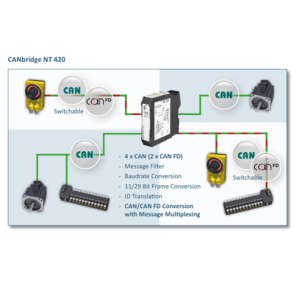
Configurable CAN-to-CAN Bridge/Router with CAN FD Support
CANbridge NT 420 comes with 4 classic CAN channels of which 2 can be configured as CAN FD channels .
Enclosure suitable for DIN Rail mounting.
This product may take upto 2 to 3 weeks for delivery.
The CANio 500 enables the easy and quick connection of various analog and digital input and output signals to CAN or CANopen systems - whether in experimental setups, component test stands or vehicles. CANio 500 is a field attachable CAN/ CANOpen I/O device available in multiple configurations as below:
Suitable for CANopen and CAN layer 2 networks
4 digital inputs + clamp 15 (between 0 ... 34 V, threshold at 50 %)
4 digital outputs, max. 1 A, output voltage free selectable
4 analog inputs, 12 bit res. (0 - +10V)
4 analog outputs, 12 bit res. (+/- 5 V, or +/- 10 V, or 0-5 V, or 0-10 V, switchable via software)
Universal use due to robust design and wide power supply range
Easy configuration and versatile configuration options
Adaptation to specific requirements via CANio ADK
Plug-in version available for direct integration into customer hardware
Flexible configuration options (combination of several CANblue II)
How it works
Bridge mode
The bridge mode allows the user to set-up a CAN-Bluetooth-CAN bridge by using two CANblue II devices. Message exchange occurs on layer 2 and is transparent. The device can also be used in systems with CANopen, DeviceNet or customer-specific protocols. CAN-ID filters can be set for data exchange via Bluetooth. Using more than 2 CANblue devices, multiple busses can be linked with each other.
ASCII/Binary protocol mode
In this mode, functions for transmitting and receiving CAN messages and for configuring the CANblue II are available to the user based on simple ASCII commands and optimized CAN binary messages. The CANblue II is ideal for "non-Windows" systems or embedded platforms.
PC operation mode with VCI driver support
Because it is supported by the VCI CAN driver, the CANblue II can be operated with all IXXAT tools and with customer-specified programs. In addition, wireless access to CAN systems via Bluetooth can also be easily achieved with existing VCI-based application programs and tools.